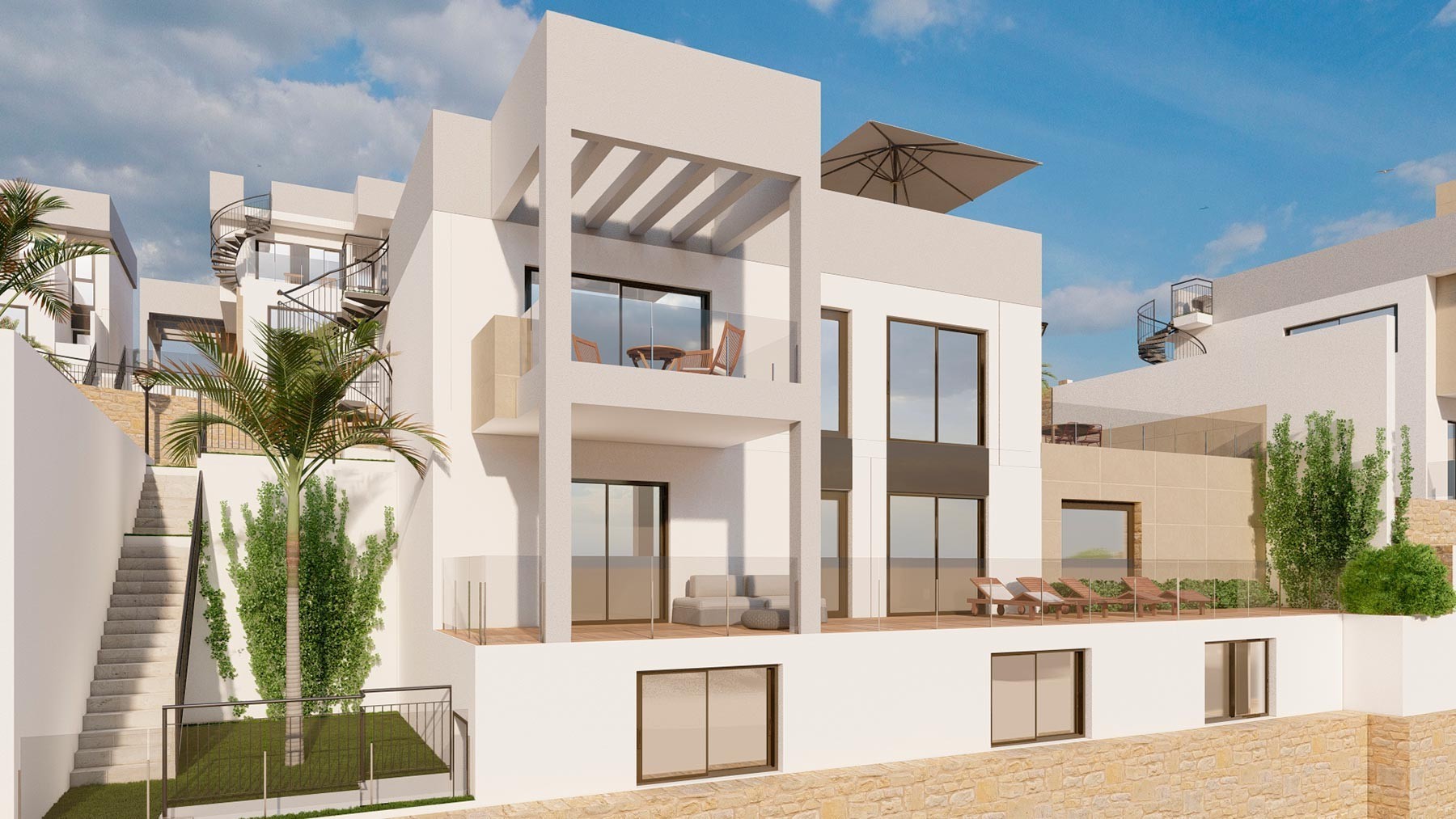
Can you use your Swiss pension to buy a home in Spain? Second pillar, pillar 3a and the rules that apply
Holiday home, main residence or retirement: what the Swiss second pillar and pillar 3a can finance in Spain, and how the capital is taxed on both sides of the border
By RB Place, estate agency for the Costa Blanca, Costa Cálida and Costa de Almería, a trading name of Fiduciaire Bleich Sàrl, Geneva
Swiss buyers ask us this more than any other financing question: can the second pillar or the pillar 3a pay for a home in Spain? The honest answer has three parts. For a holiday home while you live in Switzerland, no, the law does not allow it. For a main residence when you move to Spain, yes, under conditions. And once the capital has been paid out for another legal reason, retirement or a definitive departure from Switzerland, it is yours to use as you wish. The difference between these three cases is worth a lot of money in tax, so this guide sets out the rules on both sides of the border. The detail sits inside the FAQ sections.
⚠️ This guide describes the Swiss and Spanish rules in force in October 2026. Pension and tax law change, cantonal rates differ and your pension fund's regulations add their own conditions. Have your own case checked before you give notice to anyone.
In a nutshell
Early withdrawal or pledge of second-pillar and pillar 3a assets for home ownership (EPL) is reserved for a home you will occupy yourself as your main residence, in Switzerland or abroad. A holiday home in Spain does not qualify.
If you move to Spain, an EPL withdrawal can finance the purchase or construction of your main residence there, up to three years before you become entitled to old-age benefits, with documented proof of the move. From age 50 the amount is capped, and every withdrawal reduces your future pension.
On a definitive departure from Switzerland, the extra-mandatory part of your vested benefit is paid out in cash; for an EU country like Spain, the compulsory part is paid out only once the LPP Guarantee Fund has confirmed that you are not compulsorily insured there. A capital taken at retirement as an old-age benefit does not go through this check.
Capital withdrawn while you still live in Switzerland is taxed separately at a reduced rate. Capital withdrawn once you live in Spain is subject to Swiss withholding tax, refundable within three years because the Swiss-Spanish treaty gives Spain the right to tax private-sector pensions, and Spain then taxes it as employment income.
Spain has no split tax year: if you become resident during a year, you are resident for the whole year. The tax year of a withdrawal is the single most important decision, and you need a legal ground to withdraw at all, since a planned departure does not by itself release the capital before you leave.
Buying a holiday home in Spain while you live in Switzerland
The encouragement of home ownership (EPL) lets you withdraw or pledge second-pillar assets to buy or build a home. The condition that matters here is that the home must be for your own use, as your main residence at your place of domicile or habitual abode (art. 30c LPP, art. 1 and 4 OEPL). A second home, a holiday home, or a home you intend to live in at some point in the future does not qualify, in Switzerland or abroad. The pension fund will refuse the withdrawal, and rightly so.
Pillar 3a has its own rule, with the same purpose test: an early withdrawal is allowed to acquire or build a home for your own use, or to repay a mortgage on it, once every five years (art. 3 OPP3). The procedures differ from the second pillar, as explained in the FAQ, but a holiday home is excluded there too.
That leaves three ways to finance a Spanish holiday home from Switzerland. Your own savings, which is how most of our clients pay the instalments during construction. An increase of the mortgage on your Swiss home, which Swiss banks grant against Swiss property at Swiss rates, often the cheapest money available, provided your income supports it. And a Spanish mortgage on the finished home, which Spanish banks grant to non-residents for 60% to 70% of the value, at Spanish rates, once the home exists. Our guide to buying off plan in Spain explains why the instalments before delivery come from your own funds.
Frequently asked questions
Can I pledge my pension assets instead of withdrawing them? A pledge follows the same rules as a withdrawal: a home for your own use as main residence only. It cannot secure a loan for a holiday home.
What if I buy the home now and move there in a few years? EPL can finance the purchase or the construction of the home you are moving into, so a documented move (notice of departure from your Swiss commune, Spanish residence registration, a fixed moving date) can support an application even before you sleep there. A vague plan to retire to Spain in several years cannot: the fund assesses the use of the home at the time of the application, and a home that is not going to be your main residence now is a second home. In that case the route is to apply once the move is real, if you are still more than three years from entitlement to old-age benefits.
How do the second-pillar and pillar 3a conditions differ? Second pillar: minimum CHF 20,000 per withdrawal, once every five years, possible up to three years before entitlement to old-age benefits unless your fund's regulations are more favourable, capped from age 50 at the vested benefit you had at 50 or half of your current vested benefit, whichever is higher, and the amount must be repaid if you sell the home without buying another main residence. Every withdrawal reduces your future retirement, invalidity and survivors' benefits, and the fund may ask you to insure the gap. Pillar 3a: no minimum amount and no age-50 cap, once every five years, with the same own-use requirement; and from five years before the reference age, pillar 3a can be paid out freely for any purpose.
Moving to Spain and buying your main residence there
If the home in Spain is to become your main residence, the picture changes. You can ask your pension fund for an EPL withdrawal under the conditions above, and the fund pays the seller or the notary directly against documents. For a home abroad, where no restriction on sale can be entered in the Swiss land register, the fund will ask for proof: a notarised purchase contract, evidence of your move (deregistration from your Swiss commune, Spanish residence registration), and sometimes a bank certificate confirming the use of the funds.
The other route, for someone leaving Switzerland for good before retirement, is the cash payment of vested benefits on definitive departure (art. 5 LFLP). For a departure to an EU or EFTA country, the rule since 2007 is that the compulsory part of your second pillar cannot be paid out if you are compulsorily insured for old age, invalidity and death in the destination country; the extra-mandatory part is paid out in all cases. Not working in Spain is not proof in itself: the full payout is conditional on the written confirmation, obtained by the LPP Guarantee Fund as Swiss liaison body from the Spanish social security, that you are not compulsorily insured there. For Spain that examination takes place at the earliest 90 days after your departure, which is a starting point for the check, not a date on which payment is guaranteed. If the answer is that you are insured in Spain, the compulsory part stays in Switzerland until retirement.
A retiree is in a different situation. A capital paid at retirement is an old-age benefit, not a cash payment on departure, and the Guarantee Fund states expressly that it does not go through this check. The retiree's question is one of tax and timing, covered in the next sections.
Frequently asked questions
Which is better, EPL withdrawal or cash payment on departure? EPL is for people who move before retirement and will occupy the home as their main residence; it is capped by the fund's rules, reduces future benefits and must be repaid if you sell without buying another main residence. Cash payment on departure releases the extra-mandatory part without conditions on its use, and the compulsory part only once non-affiliation in Spain is confirmed, and only after you have actually left. The tax treatment differs too, as explained below.
What happens to the compulsory part if I take a job in Spain? It stays in Switzerland, in a vested benefits account or policy, and is paid out at the ordinary retirement age, or up to five years earlier. The extra-mandatory part is paid out in cash when you leave.
Can I withdraw pillar 3a when I leave Switzerland? Yes. Definitive departure is a reason for early payment of pillar 3a, in full, whatever the destination.
Retiring to Spain: capital or annuity, and when
At retirement you choose, within your fund's rules, between an annuity, a lump sum, or a mix. For someone moving to Spain the choice has a tax dimension. For pensions from private-sector employment, the treaty gives the right to tax to the state of residence: a Swiss annuity paid to a Spanish resident is taxable in Spain and not in Switzerland, so no Swiss withholding applies to it. A lump sum is taxable in Spain too, but Switzerland withholds tax at source first and refunds it on proof that you are resident in Spain within the meaning of the treaty and that the Spanish tax authority knows of the payment. Spain taxes both as employment income at its progressive rates, and a lump sum received in one year lands in the top brackets. Pensions from public employment follow a different treaty rule (art. 19) and may remain taxable in Switzerland, depending in particular on your nationality.
The timing question is therefore simple to state. If you take the capital while resident in Switzerland, in a tax year during which you are not Spanish resident, it is taxed in Switzerland only, separately from your other income and at a reduced rate. If you take it once resident in Spain, it is taxed in Spain at the ordinary progressive rates, with a reduction for income built up over more than two years that is possible but not automatic, as explained under Spanish tax. The gap between the two can be very large. One condition applies to both: you need a legal ground to withdraw, such as reaching the fund's retirement age or an EPL withdrawal for your main residence. A planned departure does not by itself release the capital before you have left.
Frequently asked questions
Why does the tax year matter so much? Because Spain does not split the tax year. Under Spanish domestic law, if you spend more than 183 days in Spain in a calendar year, or your centre of economic interests is there, you are Spanish tax resident for the whole of that year, from 1 January. A lump sum paid in February before a move in April may therefore fall under Spanish tax; where both countries claim you as resident for that year, the treaty tie-breakers decide (permanent home, centre of vital interests, habitual abode, nationality). The safe sequence is to take the capital in a tax year in which you are not Spanish resident, in practice the year before the year of the move.
Can I split the withdrawal over two years? Often, if your assets sit in more than one institution (two vested benefits accounts, several pillar 3a accounts). In Switzerland, spreading withdrawals over two tax years lowers the progressive rate applied to each. In Spain the picture is different: the 30% reduction for income built up over more than two years requires the income to be taxed in a single tax period, so splitting a payment can affect access to it. The two effects have to be compared for your figures, years ahead.
Is the Swiss annuity taxed in Switzerland at all once I live in Spain? For a pension from private-sector employment, no. Under the treaty it is taxable only in the state of residence, the fund pays the annuity gross, and you declare it in Spain. A pension from public employment may stay taxable in Switzerland under art. 19 of the treaty.
Tax in Switzerland
While you are resident in Switzerland, a capital withdrawal from the second pillar or pillar 3a is taxed separately from your other income, in the year of payment, at a reduced rate. In Geneva the rule is explicit: the cantonal and communal tax is one fifth of the rate of the ordinary scale (art. 41 LIPP) and the federal tax one fifth of the rate of the federal scale (art. 36 LIFD), applied to the whole capital, so a fifth of the rate, not a tax on a fifth of the capital. Other cantons apply their own reduced scales. Several withdrawals in the same year are added together for the rate. This separate taxation is the reason capital taken before a move is usually the cheaper option.
Once you live abroad, the Swiss institution deducts a withholding tax at source at the rate of the canton where it has its seat, and pays you the net. Because the Swiss-Spanish double taxation treaty gives Spain the right to tax pensions and capital benefits from private employment, this Swiss withholding is refundable in full, for the second pillar and for recognised pillar 3a schemes alike: you file the refund form with the cantonal tax office within three years of the due date of the benefit, with the attestation that you are resident in Spain within the meaning of the treaty and that the Spanish tax authority knows of the payment. If you miss the deadline, the Swiss tax stays where it is and Spain taxes the gross amount as well.
A trap for people who optimised their tax in the years before leaving: a capital withdrawal made within three years of a voluntary buy-back into the second pillar can lead the tax authority to refuse or recapture the deduction taken for that buy-back (art. 79b LPP). Anyone who bought into the fund recently should count three years before taking capital.
Frequently asked questions
Does the canton of the institution matter? For the final bill, not when the treaty gives Spain the right to tax, since the Swiss withholding is refunded. It matters for cash flow (the rate withheld until the refund) and for countries without a treaty. For Spain, the treaty applies.
What about the EPL withdrawal taken while I still live in Switzerland? Taxed separately at the reduced rate, like any capital withdrawal, in the year of payment. If you later repay the amount to the fund, the tax paid can be reclaimed.
I made a buy-back two years ago. Can I take my capital next year? You can, but the deduction you claimed for the buy-back is at risk until three years have passed since the payment. If the move cannot wait, have the cost of losing that deduction calculated against the cost of waiting.
Tax in Spain
As a Spanish tax resident you declare your worldwide income. A Swiss second-pillar benefit, annuity or lump sum, is employment income (rendimientos del trabajo) in the Spanish income tax (IRPF), taxed at the progressive state and regional rates, which reach the high forties in most regions. The Spanish tax administration confirmed this in November 2025 for a lump sum from a Swiss vested benefits account (ruling V2090-25): employment income under art. 17.1 LIRPF, taxable only in Spain under the treaty, and outside the Spanish rules for domestic pension plans. For pillar 3a, the Spanish treatment depends on the nature of the contract, bank account or insurance policy, and must be analysed separately rather than assumed to be the same.
For a lump sum built up over more than two years and received in a single year, Spanish law provides a 30% reduction on the taxable amount (art. 18.2 LIRPF), with conditions: the income must be taxed in a single tax period, the reduction must not have been used for similar income in the previous five years, and it applies to at most 300,000 euros of income. The 2025 ruling does not address the reduction, so whether it applies to your payment is a point to have confirmed in writing before you move, not after, and not a figure to build into your plan in advance.
Two further Spanish rules catch Swiss retirees. Wealth tax: the tax administration has ruled (V1049-19) that a Swiss vested benefits account is not exempt from Spanish wealth tax, unlike Spanish pension plans, so it counts in your net wealth while it exists, with the reserve that an account carrying a surrender right comparable to a life insurance policy, or the moment the pension event occurs, calls for a fresh analysis. Andalusia's 100% regional rebate on wealth tax, described in our Costa de Almería guide, has to be read together with the national solidarity tax on large fortunes, which applies above 3.7 million euros of net wealth even in Andalusia. Reporting: the Modelo 720 declaration of assets abroad does not cover a Swiss pension account until the pension event occurs, and after payment it covers the receiving bank account only if that account is located outside Spain, above the thresholds; a Spanish bank account does not enter it.
Frequently asked questions
Is a Swiss state pension (AVS) taxed in Spain too? Yes, as employment income, taxable only in Spain under the treaty. Swiss AVS pensions paid abroad are not subject to Swiss withholding.
Do I get credit in Spain for the Swiss withholding tax? No, in this case: because the treaty gives Spain the exclusive right to tax a private-sector pension, the remedy is the refund in Switzerland, and Spain does not credit a tax you can recover. Claim the refund in Switzerland and pay the Spanish tax in full. For benefits that fall under a different treaty rule, such as public-employment pensions, the analysis has to be redone.
Does the Beckham regime help a retiree? Moving to Spain to retire does not give access to the special regime for inbound workers, which requires an employment or another qualifying activity. The exclusion is not absolute, however: art. 93 LIRPF also admits, under conditions, the spouse and certain family members of a person who qualifies.
The practical sequence we recommend
Decide the use of the home first: holiday home, future main residence or retirement home, because that decides which pension rules apply. Get a written statement from your pension fund of your vested benefit, the compulsory and extra-mandatory parts, the date of any buy-backs, and the fund's EPL and lump-sum rules. Plan the calendar: the tax year of any withdrawal, the year of the move, the 183 days, the Guarantee Fund check if you leave before retirement, and the three years after a buy-back. Have a Spanish tax adviser confirm in writing how your lump sum will be taxed and whether the 30% reduction applies. Then buy, with the Spanish side of the purchase handled as described on our administrative support page. As a Geneva fiduciary, we handle the Swiss side of this analysis for our clients and coordinate with the Spanish adviser on the other.
Frequently asked questions
Can RB Place advise on the Swiss pension side? Yes. RB Place is a trading name of Fiduciaire Bleich Sàrl, a Geneva fiduciary, and the pension and tax analysis described here is part of our practice. The Spanish tax return itself is done by a Spanish adviser we work with.
How early should I start? Two tax years before the move if you want to split withdrawals; three years before if you have made a buy-back; and in any event early enough for the capital to be paid in a tax year in which you are not yet Spanish resident, if you want it taxed in Switzerland rather than in Spain.
Final thoughts before you count on your Swiss pension
Swiss pension capital is the largest asset most of our clients own, and the rules around it are stricter abroad than people expect. It cannot buy a holiday home while you live in Switzerland. It can finance your main residence in Spain if you move, and it becomes free money once paid out at retirement or on departure. What decides how much of it reaches the Spanish notary is the calendar: which year you take it, where you are resident that year, whether a recent buy-back locks it, and whether the Swiss withholding is reclaimed. Plan that part before you fall in love with a villa, and the rest follows.
At RB Place, we support our clients at every stage, from finding the property through to signing, including the administrative and tax formalities.
Sources and official references
Encouragement of home ownership, art. 30c to 30g LPP, and buy-backs, art. 79b LPP (RS 831.40): fedlex.admin.ch
Ordinance on the encouragement of home ownership (OEPL, RS 831.411), art. 1, 4, 5 and 6: fedlex.admin.ch
Pillar 3a and home ownership, art. 3 OPP3 (RS 831.461.3): fedlex.admin.ch
Cash payment of vested benefits on departure, art. 5 LFLP (RS 831.42): fedlex.admin.ch
Cash payment on departure to an EU/EFTA country, procedure of the LPP Guarantee Fund: sfbvg.ch
Federal Social Insurance Office, home ownership with pension assets: bsv.admin.ch
Taxation of capital benefits in Geneva (one fifth of the rate, art. 41 LIPP and art. 36 LIFD): ge.ch
Deduction of buy-backs and the three-year rule: ge.ch
Withholding tax on pension benefits paid abroad and refund under treaties, Geneva country table including Spain: ge.ch (PDF)
Double taxation treaty Switzerland-Spain (RS 0.672.933.21), art. 18 on pensions and art. 19 on public remuneration: fedlex.admin.ch
Spanish income tax, employment income, 30% reduction and inbound-worker regime, art. 17, 18 and 93 LIRPF (Law 35/2006): BOE-A-2006-20764
Spanish tax administration ruling V2090-25 of 5 November 2025 on a lump sum from a Swiss vested benefits account: DGT, via Iberley
Spanish tax administration ruling V1049-19 on a Swiss vested benefits account, wealth tax and Modelo 720: DGT, via Iberley
Spanish tax administration, tax residence and income from Switzerland: Agencia Tributaria
This article is for information only and is not tax, pension or legal advice. Rules differ by canton, by pension fund and by personal situation; have your case analysed before taking any decision. Information current as of October 2026.